
Lue sama artikkeli suomeksi täältä: https://www.vt-tek.fi/articles/energiamurros-sijoituskohteena
Energy transition is a structural change in energy conversion. It is already ongoing and not a blurry future image. For investors, whether institutional or private, the energy transition creates new opportunities, and also risks. There will be new markets, new products, new solutions, but also new opportunities for existing market players.
In this blog text, some ideas on where to look potential investment cases are provided. The recommendations are based on general comparison between technologies. Detailled, company-level advise is not given.
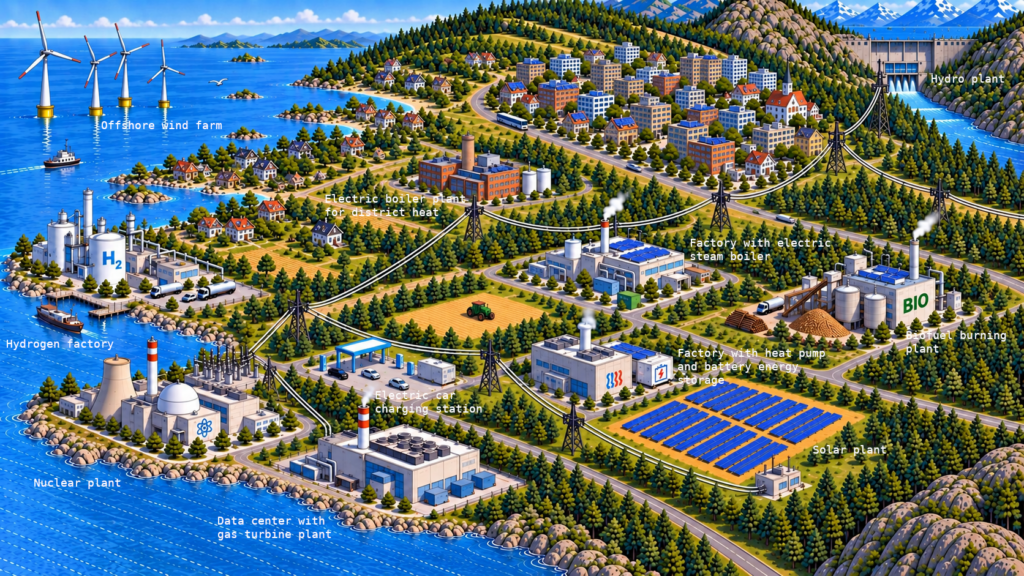
Figure 1. Illustration on the future society after the energy transition. (Picture generated in co-operation with AI.)
Introduction to energy transition
Energy transition basically means that the fossil fuels are phased out as much as possible, and replaced with renewable energy sources or nuclear power. Coal or oil burning industrial processes and traffic are electrified. Industrial process efficiency is improved. Electricity is used in more controlled way, and the energy is stored to balance consumption.
At the same time, great share of industrial work is replaced by machines working on electric power, let them be robots or artificial intelligence. Ultimately, we are going to use significantly more electric power than before.
To generate electricity, nuclear plants, old giant hydro plants, and biofuel burning boiler plants are still going to be used. They are qualified for the energy transition. Natural gas burning plants will be needed as auxiliary plants offering adjustable power. But a great share of the energy conversion will belong to wind and solar.
Wind farms and solar plants have high rated power, but due to their natural weather dependency, relatively low energy yield. At optimal conditions these plants produce too much electricity, but at poor conditions they produce almost nothing. As a result, the price of electricity fluctuates very strongly.
It makes therefore sense to store the energy somehow. Pumped hydro plants, which move the water back to the reservoir, or gas storage plants, which compress the gas into underground cavities, can be used as today, but this will not be enough. Even small- and medium-sized factories are encouraged to invest in battery storage, which charges the batteries when the price of electricity is low, and feeds the power back to the system, when the price is high.
District heating in cities should remain similar from the end-user perspective. But the way the heat is generated will change. Biofuel or gas burning plants and waste incinerators can still be used, but large part of district heat will be produced with electric boilers, giant heat pumps, or waste heat from local data centers.
All the above-mentioned electrical installations are connected to so-called smart grid. It is the same National grid as before, but contains more advanced features for energy management, for example allowing smooth change from electricity production to consumption for a given industrial site. Smart grid is also equipped with more sophisticated measuring and protection equipment than the former National grid. Still, regarding the grid, the word ”smart” remains somewhat misleading. Grid codes, standards, and general requirements on reliability and safety place boundaries, and the grid applications will not be as versatile as the ones inside the industrial plants.
The big picture of changes
Let us dig a bit deeper into the technology behind the energy transition.
Significantly more electric power
We can estimate the electricity consumption to double within the next few decades. This has been discussed in earlier blog post (Finland needs more electrical power), but the analysis at the time did not take the AI data centers into account. Some estimates from different countries are collected in Figure 2. Huge growth in electricity consumption increases the size of the total market for electrical component manufacturers and contractors.
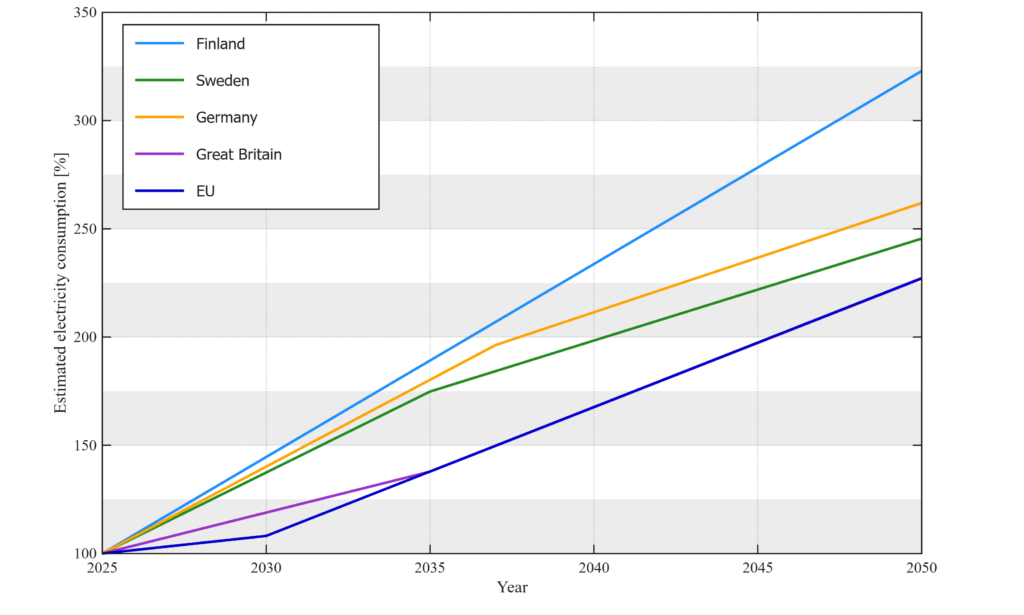
Figure 2. Estimates on electricity consumption increase in different regions. See references 1-5.
Distributed generation with smaller power plants
Old power plants are often very large and located close to the consumers, at the outskirts of the city they deliver the power to. Wind turbines are small units installed in large numbers in wind farms. They are built on locations with high winds, for example offshore, nowhere near the consumers. Solar plants are huge installations, containing hundreds of hectares of land. They need large plots of low-value land, which diverts their locations to far away from cities, and consumers.
In Finland, the wind power is produced in the Gulf of Bothnia and solar power in the eastern wastelands, both several hundreds of kilometres away from Helsinki, where the great deal of power will be used. The National grid will be heavily loaded, and will require more capacity.
As the electricity generation is moving from few large units to many small units, the number of transformers and switchgears will increase, and there will be more cabling.
Managing the fluctuating electricity price
Earlier, the factory had only one supply of electricity, the National grid. They had alternative energy sources by using fossil fuels. The future factories use only electricity, but they still have alternatives. Electricity can be bought from National grid, produced in rooftop solar plant, or diesel generators, or recovered from battery storage.
Factories have incentives to use energy storage units to balance the plant power. The purpose is twofold: to use stored energy when the electricity price is high, and to balance the high load peaks to save money on peak power charges.
The grid companies are charging additional cost for high power peaks. They are not only invoicing for the kWhs of energy, but also based on the maximum kW reading. This has been industry standard for a long time, but it is now spreading to the households as well.
Bigger role of power electronics
Old power plants were connected directly to the switchgears, transformers, and National grid. They were fixed with the National grid frequency.
However, wind, solar, and energy storage plants are connected to converters, which adjust the power to match the National grid requirements. In the same manner, the heat pumps are operated with frequency converter driven motors, and electric boilers are fed by thyristor drives. To sum up, ever larger share of the total electrical power consumed will flow through power electronic components.
Data centers as large consumers
Data centers are one form of future factories, but they overlap with energy transition. First, they use excessive amounts of electricity and require a dedicated National grid interface. They also produce lots of waste heat, which can be used for district heating. Third, the data centers contain many synergies with energy transition investments: transformers, switchgears, cabling, emergency power generators, to name just some examples.
Data centers need stable and uninterrupted electricity supply, and they consume so much of it that they may find it useful to build an own power plant. For this purpose, gas turbines are often favoured. Further, the data centers have high reliability requirements, for which they need lots of emergency power, both diesel generators and UPS.
Technical readiness levels are questionable
When new technology is introduced, it does not always work instantly. It may have been tested in the laboratory or manufacturer’s test stand, but it is not proven technology before it has been proven in service. So, the newly introduced energy transition solutions do not necessarily have the highest possible technical readiness level. They are hence more vulnerable to failures and undesired service outages, which cause economic issues.
It is worth looking into branches of industry that have proven technology and high technical readiness levels, but potentially new markets due to energy transition. Electric boilers should be a safe choice in this respect. High power heating elements have been used extensively in the oil refineries, not just in making district heat or process steam. Another example are the high power heat pumps, which are based on natural gas compressors with long track records.
Technologies becoming redundant
Old power plants have extensive auxiliary systems: silos, conveyor belts, and feeding screws for solid fuel, network of oil pipes with valves, filters, tanks, and pumps. These systems are quickly becoming obsolete. Old plants also have complicated feedwater pipe network again with valves, filters, tanks, and pumps, and another complicated piping network for the process steam. These systems will still be needed, and they may find synergies with data center water cooling systems. But some components, for example the ones related to high-pressure steam, will face shrinking market.
Burner plants require considerable amount of maintenance to clean up the filters and burners from ash, soot, and other particles that stack on the surfaces. The maintenance work will reduce, although there is some synergy with a growing market of emergency diesels.
Old plants often have certain types of explosive atmospheres, and therein systems labelled as EX. Components with EX label are – obviously – much more expensive than regular components. With wind, hydro, and solar and with electric boilers, the EX-environments are not relevant. With heat pumps, they may be depending on the refrigerant, but even then they are limited to a very small area around the heat pump. EX equipment will be needed, if the Hydrogen economy concept spreads, but the old equipment designed for oil or natural gas will most likely be incompatible with Hydrogen.
First assumptions for the investment case
To narrow down the investment potential, we can make some assumptions:
- Demand of oil and gas will stay approximately constant in the western world, but there will be less investments for the new production facilities. Gas turbine power plants are still used and great share of traffic will remain powered by fossil fuels.
- New hydro power capacity will be built only in the mountain areas (in Norway and in the Alps). Hydro power is based on existing large plants.
- Hydrogen economy is still far away, and should be considered as a high risk investment. Many plans have been postponed due to significant technology gaps. It seems that the Hydrogen will rather be further processed into Ammonia or Methane than transported in pipelines. If this scenario spreads, the Hydrogen economy is practically a subsidiary of oil and gas.
- Wave and tidal energy are not going to spread in the near future. They still contain considerable technology gaps. However, their technology should finally contain many similarities with offshore wind.
- Batteries of electric cars will not be used as energy storage, except in second life application (i.e. once the vehicle is taken out of service). The car owners will not allow this. The smart grid applications and solutions focusing on this feature can be neglected.
- Nuclear power will be renovated. Nuclear is popular again, but the technology of future plants is unclear. Legislation is slowly changing to support small, modular reactors. Also, the existing plants are very old, and their technology is largely out of date. It seems that the future nuclear plants will be built completely differently to the old ones, including the auxiliary systems. Furthermore, nuclear technology might overlap with fusion energy technology, which has taken considerable steps forward lately. In the future, nuclear power might also be used for local generation of district heat.
- Businesses with strong China-dependency contain geopolitical risk. This includes at least batteries, solar panels, and permanent magnets, to name just a few. Naturally, Chinese companies have been very innovative and hard-working to bring them into the position there are in now. But still, for us Europeans investing into Chinese production is not straightforward, and the profitability may change suddenly due to political decisions.
Some investment ideas
Based on the above considerations, the following ideas arise.
Transformers and switchgears
This is an interesting feature of high-tech applications: More and more low-tech components are needed to power them up. There will be more switchgears, both medium- and low-voltage, and more distribution transformers. They all have more or less standardised methods of construction.
The market grows for the switchgear manufacturers, but also and perhaps even more for the ones producing the components inside the switchgears, such as fuses, miniature circuit breakers, relays, contactors, current transformers, and A/D-converters.
It is also interesting to note that modernising or retrofitting old factories often requires completely new electrical systems. The old installations are usually at the end of their technical life, and they are incompatible with additional power sources, such as factory roof solar panels, emergency diesels, and energy storage units.
Furthermore, the transformers and switchgear components have successfully passed complicated prototype tests and proven track records. Hence, they have high technical readiness levels. Founding new competing factories will be a slow process. Hence, it is expected that the existing players on the market will collect the most of the growth.
Grid infrastructure
Due to increased electric power, the National grid capacity needs to be increased. This requires investments to switchyards, substations, and perhaps even completely new power lines.
Great deal of grid infrastructure bugdet is used by the contractors, not so much by the component suppliers. Also the grid improvement projects are designed more carefully with more control over who can be selected as design engineers. This means increased turnover for the design companies as well.
In addition, grid infrastructure has traditionally been one of the most profitable businesses in electrical engineering.
Uninterruptible power supply (UPS) units
UPS systems have many synergies with battery energy storage systems. Both have battery banks, chargers, converters, and sophisticated control systems.
Further, increased need for plant management, control, and cyber security require more UPS equipment on site. Automation systems and process computers are not allowed to run down due to local power outage. Emergency diesel generator is insufficient for this purpose, because it takes too long to start up. The future factories will all have UPS, it is just a matter of which size.
Energy management software
The power plants need to be more aware on weather conditions and price of electricity. Factories need to monitor their processes and power consumption more accurately. Both require advanced energy management features for the plant automation system.
The software provider may sell its products to the automation systems provider, and not necessarily to the end-customer. Here, it is worth keeping in mind that the electrical component manufacturers have traditionally been notoriously incompetent with software. A company dedicated in software and code has a clear advantage.
Cyber security
The factories and power plants are still built by hard-wiring all instruments to the automation system. Wireless IoT devices are not favoured. However, the plants still need to communicate with outside world: to monitor electricity price, to communicate with distributed plants, to allow unmanned operation, and so on. Hence, there are plenty of interfaces, where attackers could infiltrate.
Furthermore, there are synergies with general industrial processes — even the ones not related to energy transition at all. They are changing to more automatic, and they use more and more artificial intelligence -assisted tools. This improves the factory performance, but it comes with risks. The AI tools may have vulnerabilities, and basically they might even generate more of them by just learning things the wrong way. Cyber security measures are needed to monitor the AI tools.
Conclusions
Energy transition is going to change the energy conversion. Many of the features listed in this text are already happening, and the investment cases are also considered accordingly. Some of them might have been more attractive to invest in a couple of years ago, but it is still not too late. The transition process is expected to go on until at least 2040.
Electrical engineering has more interfaces with other disciplines than before. Power plants and factories need to be more aware and more intelligent, because the production is more scattered, more controlled, and more complicated.
References
- “Electricity system vision 2025” by Fingrid. Final report, October 2025. Available in Finnish at: https://www.fingrid.fi/globalassets/dokumentit/fi/kantaverkko/kantaverkon-kehittaminen/sahkojarjestelmavisio-2025/fingrid-sahkojarjestelmavisio-2040.-loppuraportti-10_2025.pd. (Scenario “Power to data” used in Figure 2.)
- “Svenska kraftnät skruvar upp elförbrukningen i nya analyser” by Svenska Karftnät, 24.1.2024. Available at: https://www.svk.se/press-och-nyheter/press/svenska-kraftnat-skruvar-upp-elforbrukningen-i-nya-analyser—3410239/. (Scenario “EP” used in Figure 2.)
- “Netzentwicklungsplan Strom 2037 mit Ausblick 2045, Version 2025, zweiter Entwurf” by NEP. Version 2025, 2nd draft. Available at: https://www.netzentwicklungsplan.de/sites/default/files/2026-03/NEP_2037_2045_V2025_2_Entwurf_kompakt_DE.pdf. (Scenario “C” used in Figure 2.)
- “Future Energy Scenarios: ESO Pathways to Net Zero” by National Grid Electricity System Operator Limited. July 2024. Available at: https://www.neso.energy/document/321041/download. (Scenario “EE” used in Figure 2.)
- “Europe’s 2040climate target &path to climateneutrality by 2050” by Eurelectric. February 2024. Available at: https://www.eurelectric.org/wp-content/uploads/2024/06/2040-communication-impact-assessment-eurelectric-analysis.pdf. (Scenario “S3” used in Figure 2.)
